Day 1
Arrival in Casablanca
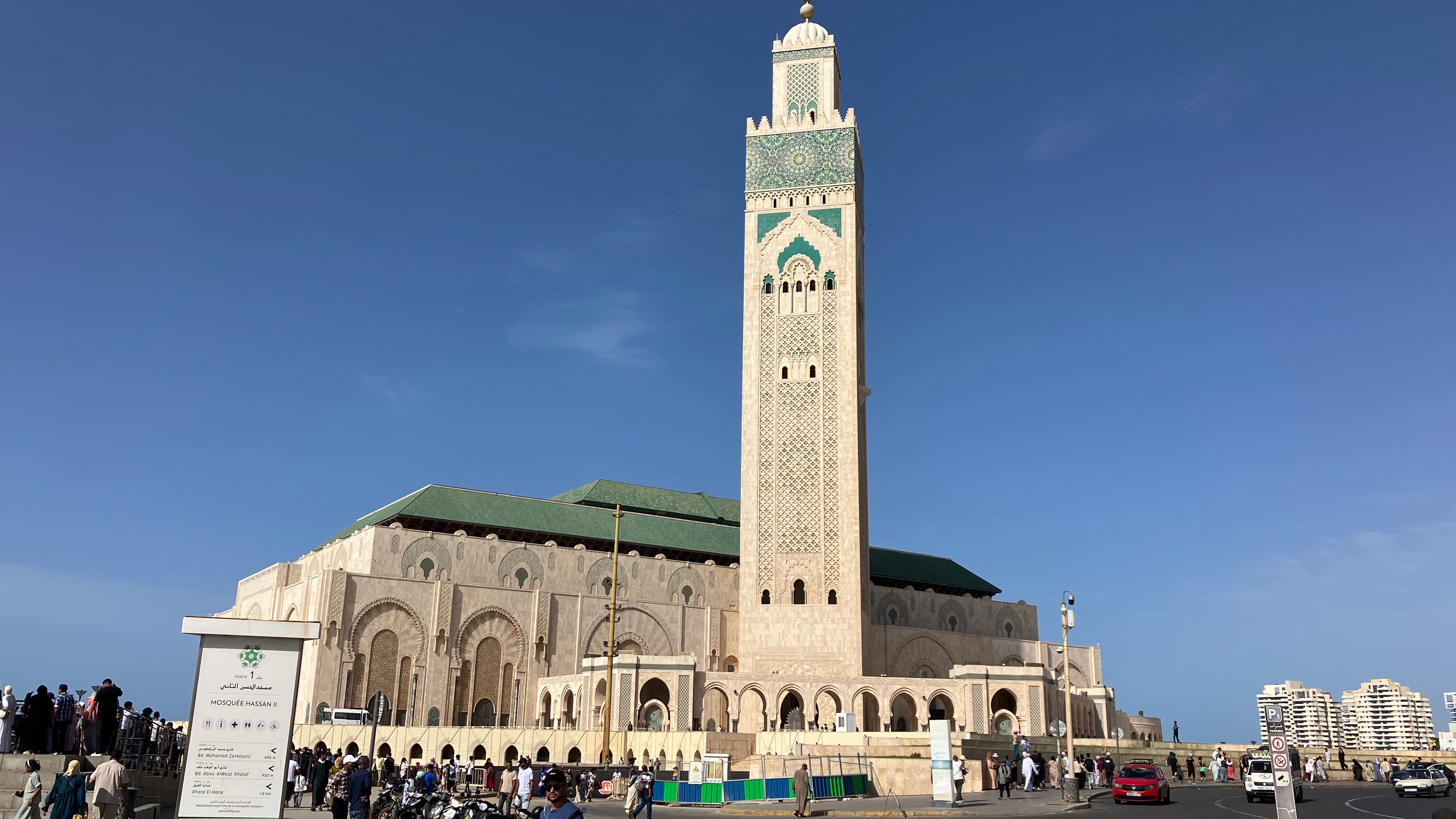
The longest of our Casablanca itineraries opens with the simplest day on it: pick-up at Mohammed V Airport and a half-day looking around the city before the road trip begins in earnest tomorrow. The Hassan II Mosque is the obvious anchor, close enough to the ocean that the call to prayer competes with breaking waves, but leave time too for Mohammed V Square and a slow walk along the Corniche as fishing boats come in and the evening crowd settles onto café terraces. Overnight in a Casablanca hotel.
Day 2
Casablanca to Assilah via Rabat
Drive north to Rabat, where the Mausoleum of Mohammed V's green-tiled roof and marble interior stand in deliberate contrast to the unfinished Hassan Tower right beside it — a reminder of how ambitious the original 12th-century mosque project was before it stalled. Continue up the Atlantic coast to Assilah, a small fortified fishing town that leans into its whitewashed walls as a canvas, repainting them with new murals each summer for an arts festival that draws artists from across the region. Settle in for the night.
Day 3
Assilah to Chefchaouen via Tangier
Tangier spent much of the early 20th century as an internationally administered zone rather than fully under any single government, and that unusual history still shows in its layered mix of European and Moroccan architecture. The morning here takes in Cape Spartel, where the Atlantic visibly meets the Mediterranean, and the Cave of Hercules, whose main sea-facing opening happens to resemble a map of the African continent. By afternoon, the road climbs into the Rif Mountains, reaching Chefchaouen as the light turns gold over its blue rooftops.
Day 4
Chefchaouen Sightseeing
No fixed schedule beyond breakfast today — just Chefchaouen's blue-washed medina at whatever pace you like. Nobody fully agrees on why the town is painted blue; explanations range from a symbolic link to the sky in Jewish tradition to a simple, practical deterrent against mosquitoes, and locals will happily argue for their preferred version. Most travelers spend part of the afternoon on the roughly 45-minute hike to the old Spanish mosque, whose hillside view over the rooftops is hard to beat anywhere else on the trip.
Day 5
Chefchaouen to Fes via Volubilis and Meknes
By day five, the trip shifts from the coast and the Rif into Morocco's cluster of imperial cities, starting with Volubilis, whose mosaic floors and standing columns are among the best-preserved Roman remains in North Africa. Meknes comes next, less visited than Fes or Marrakech despite its own history as an imperial capital, with the monumental Bab Mansour gate and the royal stables built under Sultan Moulay Ismail as its main landmarks. The day ends in Fes, with time to settle into your riad before dinner in the medina.
Day 6
Fes Medina
Six days in, Fes el-Bali is the densest single stop on the whole trip: a UNESCO-listed medina holding an estimated 9,000 alleyways within its walls, along with hundreds of mosques, workshops, and fondouks (old merchant inns) that most visitors would otherwise walk straight past. A guide threads a route through the highlights — the Royal Palace gate, the Mellah quarter, the Al Quaraouiyine mosque and university, and the Chouara tanneries — that would be easy to miss entirely on your own.
Day 7
Fes to Merzouga via the Middle Atlas
Day seven marks roughly the halfway point of the trip, and the scenery shifts accordingly: Ifrane's European-style architecture and pine air give way to the cedar forests around Azrou, home to one of the last significant wild populations of the endangered Barbary macaque, then to Midelt's fruit orchards and the Ziz Valley's ribbon of palm trees as the land dries out toward true desert. In Merzouga, leave the vehicle behind for a camel and ride into the Erg Chebbi dunes as the light turns gold at sunset.
Day 8
Merzouga Exploration
One night at the dune camp barely scratches the surface of the Merzouga area, so today swaps the camel for a 4x4 and stays local. A Berber family living semi-nomadically at the desert's edge usually welcomes visitors with mint tea and a look at daily life that hasn't changed drastically in generations, while Khamlia's Gnaoua musicians, whose ancestors arrived via trans-Saharan trade centuries ago, perform rhythms historically used for spiritual healing. Rainfall permitting, a seasonal lake nearby sometimes hosts migrating flamingos.
Day 9
Merzouga to the Dades Valley
Leaving Merzouga, the road passes through Rissani, once the seat of power for the region and still the site of a genuinely working souk rather than one geared toward visitors, and Erfoud, where workshops cut into fossil-rich rock formed long before the Sahara was ever a desert. From there, the Todra Gorge narrows dramatically, its rock walls climbing several hundred meters on either side of a road barely wide enough for two vehicles, before an overnight stop in the Dades Valley.
Day 10
Dades Valley to Marrakech
This is the day the landscape shifts from desert-adjacent to distinctly mountainous: first the Rose Valley near Kelaat M'Gouna, fragrant each spring during the annual rose harvest, then Skoura's palm oasis and Ouarzazate, where the desert light has drawn film productions for decades. Ait Ben Haddou's earthen ksar, periodically rebuilt as pisé walls erode, comes next, before the long climb over the Tizi n'Tichka pass and the descent into Marrakech by evening.
Day 11
Marrakech Medina Tour
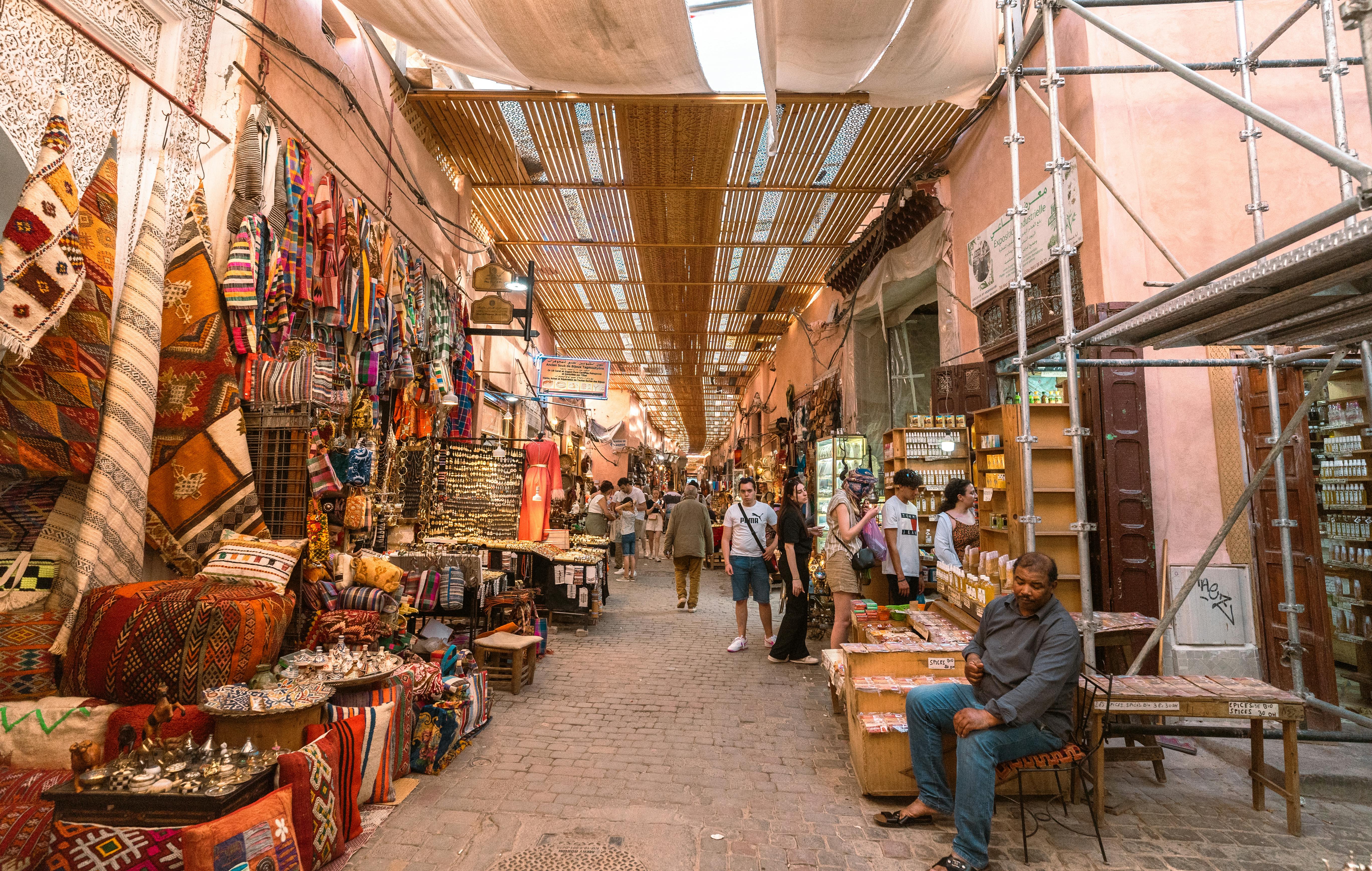
Eleven days in, Marrakech feels like a fitting near-final stop: bigger and more chaotic than Fes, with the Bahia Palace's carved ceilings and the Ben Youssef Madrasa's quiet stucco interiors as counterpoints to the souks' noise and the scale of Jemaa el-Fnaa itself. The Koutoubia Mosque's gardens make a good midday break between the two. As evening falls, the square fills with storytellers, musicians, and food stalls, and there's a case for lingering here longer than the itinerary strictly allows.
Day 12
Marrakech to Essaouira
Twelve days after starting in Casablanca, the last landscape change of the trip arrives on the drive to Essaouira, roughly three hours west, with a stop along the way at an argan oil cooperative — one of several women-run collectives that have turned a traditional Berber staple into a genuine export industry. The fortified medina and its working fishing port appear by early afternoon, with the rest of the day open for the ramparts, the thuya-wood workshops, and a seafood dinner near the harbor.
Day 13
Free day in Essaouira (or return to Marrakech)
A genuinely unscheduled day — the only one on this itinerary. Stay in Essaouira and spend it at whatever pace you like, from the beach to the medina's galleries, or head back to Marrakech at leisure if you'd rather do a final round of shopping before flying home. We confirm which direction makes more sense once we know your departure details.
Day 14
Departure
Transfer to Marrakech or Casablanca airport, depending on where your flight departs from and which option you chose for day 13. Either way, we build in comfortable time to reach the airport rather than cutting it close after two weeks on the road.