Day 1
Arrival in Casablanca
Your driver meets you at Mohammed V Airport, and this first day is treated as an orientation before nine more travel days begin: a half-day looking around Casablanca rather than jumping straight onto the highway. The Hassan II Mosque's prayer hall alone holds around 25,000 worshippers indoors, with room for tens of thousands more on the surrounding esplanade during major holidays, and its minaret can be seen from most of the city. Round out the afternoon with a walk around Mohammed V Square and along the Corniche as the evening crowd arrives. Overnight in a Casablanca hotel.
Day 2
Casablanca to Chefchaouen via Rabat
Leave after breakfast for Rabat, which despite functioning as Morocco's capital today has a noticeably quieter, more residential feel than Casablanca. A couple of hours goes toward the Hassan Tower, an unfinished 12th-century minaret standing among rows of stone columns, and the neighboring Mausoleum of Mohammed V, guarded around the clock by mounted royal guard in ceremonial uniform. From there it's a longer stretch north through changing scenery as the road climbs into the Rif Mountains, arriving in Chefchaouen by early evening in time to catch its blue-washed streets in golden hour light.
Day 3
Chefchaouen to Fes via Volubilis and Meknes
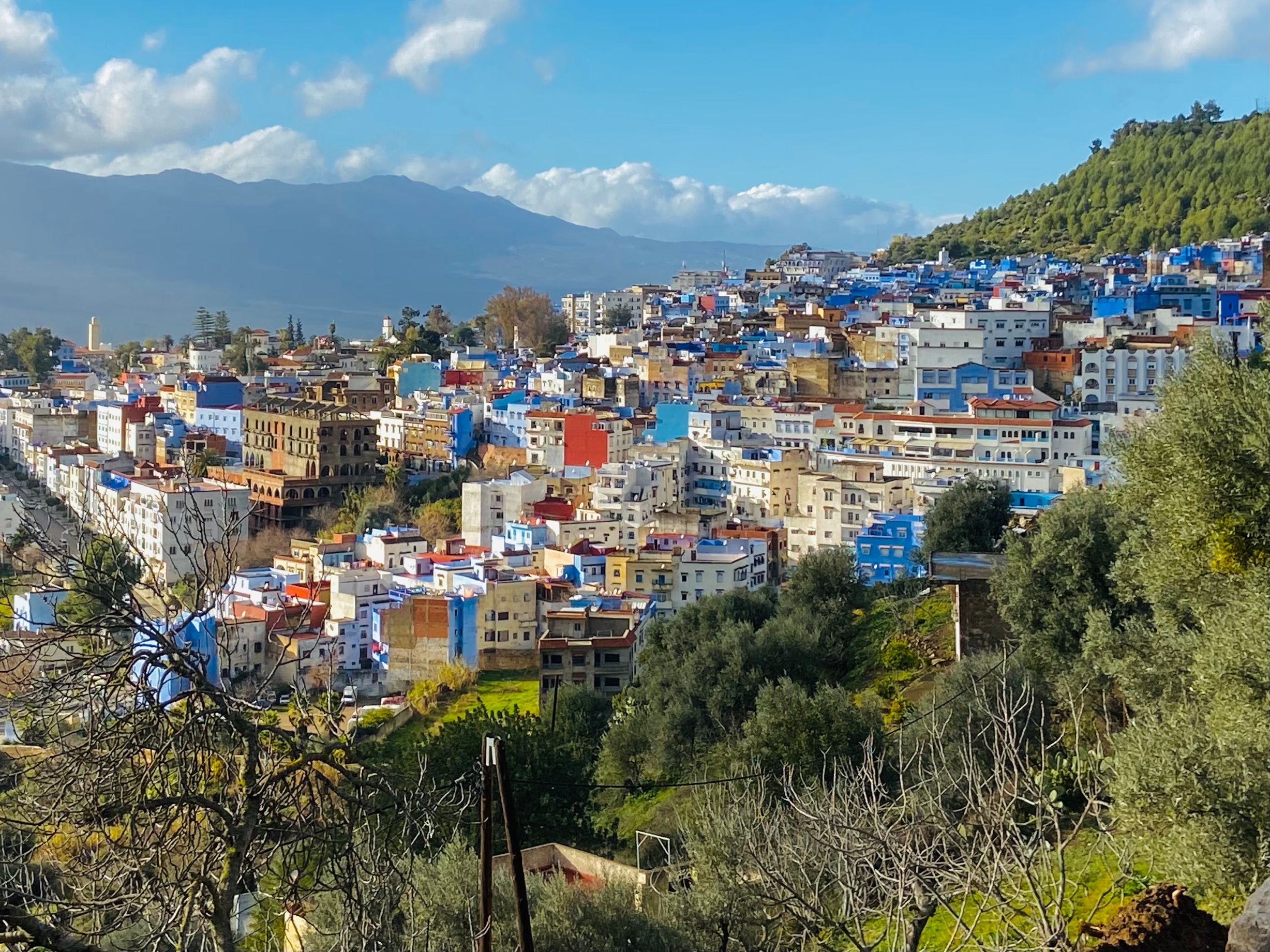
Spend the morning wandering Chefchaouen's steep, narrow lanes, where nearly every wall, door, and stairwell is painted some shade of blue — a tradition with several competing origin stories, none confirmed. By midday, head south to Volubilis, where mosaic floors and standing columns mark what was once a thriving Roman provincial capital. A short stop follows in Meknes to see the monumental Bab Mansour gate and the vast royal stables before continuing on to Fes for the evening.
Day 4
Fes Medina
Fes el-Bali has no real grid to speak of, so this full day stays with a local guide rather than risking a wrong turn down one of its roughly 9,000 alleyways. Expect the Royal Palace gate's brass-studded doors, a walk through the Mellah — the old Jewish quarter, distinguishable by its wrought-iron balconies, a style borrowed from Mediterranean rather than Islamic architecture — and the Chouara tanneries, where hides are still dyed by hand in vats arranged like a giant paint palette seen from above.
Day 5
Fes to Merzouga via the Middle Atlas
Depart Fes heading south through Ifrane, whose sloped roofs and stone chalets look more like the European Alps than anywhere else in Morocco, then continue into the cedar forests around Azrou, where wild Barbary macaques regularly appear along the roadside looking for handouts (feeding them isn't recommended, but watching is free). The road drops through Midelt and follows the Ziz Valley's ribbon of palm groves as the terrain flattens into pre-Saharan plains. In Merzouga, leave the vehicle for a camel, timed to reach the desert camp as the dunes catch the last light of the day.
Day 6
Merzouga Exploration
Rather than backtrack out of the desert the next morning, this day stays around Merzouga to see parts of the region a one-night stop skips entirely. An early start can catch the sunrise from a dune crest before breakfast, followed by a 4x4 excursion to visit a Berber nomad family living at the desert's edge, and on to Khamlia, a small village known for its Gnaoua musicians descended from sub-Saharan trade caravans. When conditions allow, the route also passes a seasonal lake that draws migrating flamingos — a striking, unexpected sight against the sand.
Day 7
Merzouga to the Dades Valley
Leaving Merzouga after two nights, the first stop is Rissani, once the historic capital of the Tafilalt region and birthplace of Morocco's current royal dynasty, still busy with a livestock and produce souk on market days. Erfoud follows, where local workshops cut open blocks of stone containing fossilized sea creatures older than the dinosaurs and polish them into tabletops and sinks. From there, the road climbs into the Todra Gorge, its walls rising several hundred meters overhead, before an overnight in the Dades Valley, sometimes called the Valley of a Thousand Kasbahs.
Day 8
Dades Valley to Marrakech
The Rose Valley around Kelaat M'Gouna turns pink and fragrant each May when the annual damask rose harvest begins, most of it destined for cosmetics and rosewater rather than export as cut flowers. West of there, Skoura's palm groves once marked the last resupply point before the open Sahara for camel caravans, and Ouarzazate's film studios have used the surrounding desert as a stand-in for everywhere from ancient Egypt to fictional deserts on other planets. Ait Ben Haddou's fortified ksar follows before the final climb over the Tizi n'Tichka pass into Marrakech.
Day 9
Marrakech Medina Tour
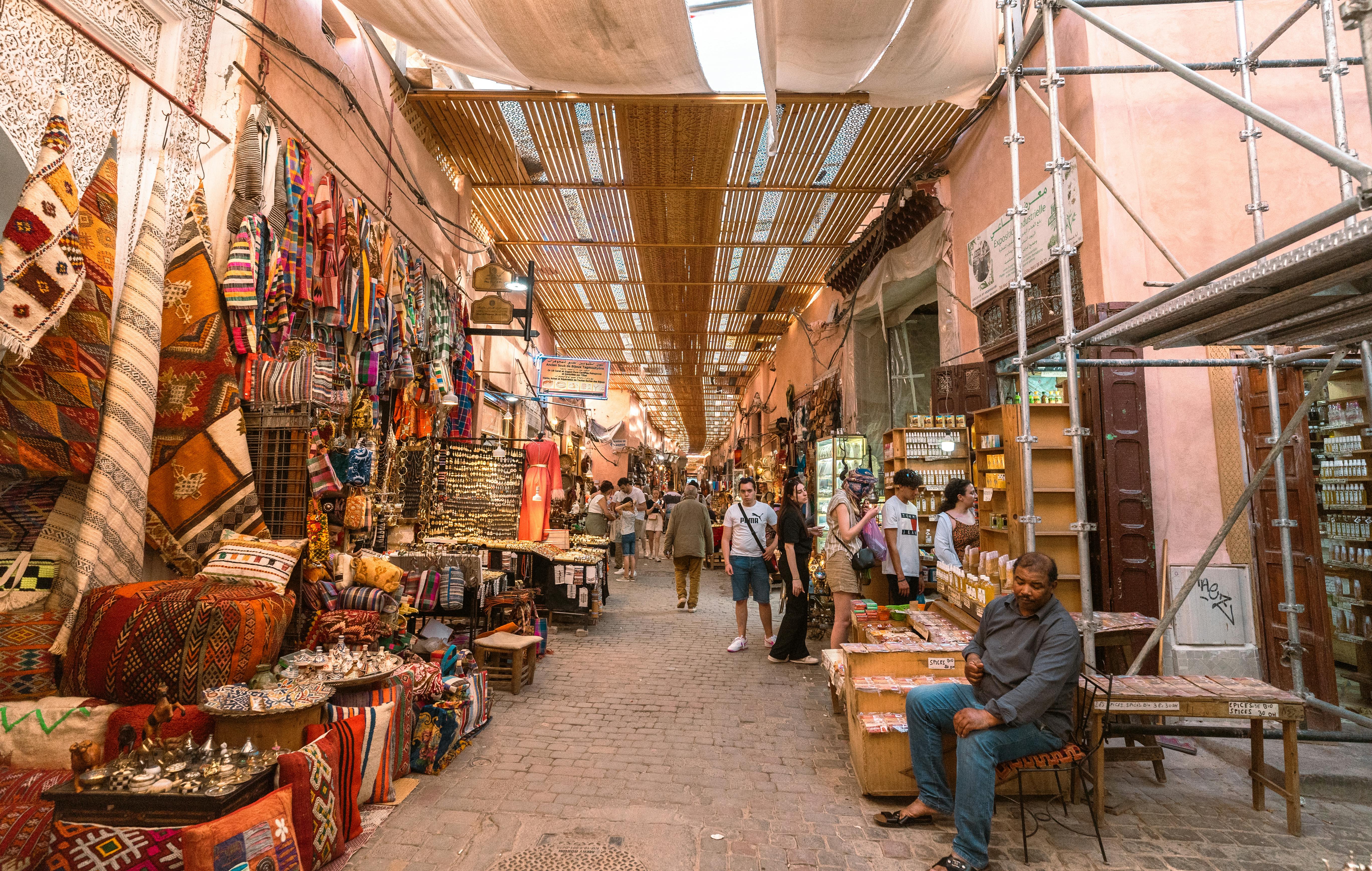
Ben Youssef Madrasa anchors this guided day, its carved stucco and cedar galleries dating to a 16th-century expansion that made it the largest Quranic school in North Africa at the time. The Bahia Palace, built centuries later for a powerful grand vizier, offers a different kind of grandeur — sprawling courtyards rather than a single ornate hall — before the afternoon shifts into the souks, each quarter given over to a different trade. The day closes at Jemaa el-Fnaa, where the square transforms after dark into an open-air stage for storytellers and musicians.
Day 10
Marrakech to Casablanca
A more direct final day, retracing the highway north to Casablanca in around three hours. We build in enough buffer time for your flight, so the pace is relaxed rather than rushed, and the tour ends with drop-off at Mohammed V Airport or your hotel.